By Rebecca
We have all heard different things referred to as a “dying art form”. What is worse is an
art form that isn’t dying, yet no one is sure what it means because no one cared until it
was too late. That was the impression I was left with after visiting the Berks County area
in Pennsylvania to learn about hex signs.
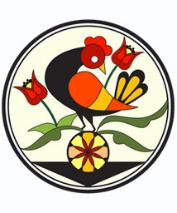
Hex signs, at their most basic, can be defined as geometric folk art associated with the
Pennsylvania Dutch. Driving around the Berks area you will see these giant disks
decorating barns. Sure, they are colorful and decorative, but what does it mean?
You see, there are several schools of thought in regards to the hex sign. They’re all
very interesting, and if you want to learn more I would suggest “Hex Signs” by Don Yoder
and Thomas E. Graves, or better yet, to visit the area. Now that we’ve established that
there is a lot of potential information and speculation attached to these symbols, you can
forgive me for hitting the high points.
One approach is to view the hex signs as Dutch folk art, which regardless of what else
these signs may be, they are most definitely art. Hex signs appear on important
documents and are incorporated into furniture dating back to the 1800s. Scholars say
there were/are eight basic designs that are the root of all hex signs: rosette, four-point
star, five-point star, six-point star, eight-point star, twelve-point star, swirling swastika,
and wheel-of-fortune (or barn wheel). These were put on barns as decoration and to
establish an ethnic identity.
Other folklore associates the hex sign with an occult element. They argue that the term
hex comes from the German word for witch, hexe. Some interviews have revealed that
hex signs on barns may have a talismanic purpose, such as being there to promote
fertility, protect livestock, provide good luck, etc. With hex signs, being giant disc with
radiating designs also provides a possible link to the sun disc symbolism, central to the
worship of the sun. There are hexologists who have dedicated years towards trying to
discover the underlying meaning of these symbols, and there are modern artists that
create their own hex signs based on these principles.
In addition, as some argue with the evidence of swastikas on ancient structures, hex
signs are basic designs. Symbols that a farmer could handle and that they were just
born out of the inevitable desire for easy embellishment of the family barn.
Unfortunately, the family farm is a dwindling enterprise. With the sale or abandonment
of barns, so goes the hex sign. At this point the owners of most barns that display hex
signs will tell you that they are there because their father had them on his barn and his
father did too, etc. or that they are there to remain true to the architectural design of the
era. The fact is, no one concerned themselves with hex signs until there was no one left
to definitively explain if they hold a deeper meaning.
In my opinion, it’s personal belief that gives a symbol its power. For example, a cross
probably is not a very potent symbol to a Muslim, but obviously for a Christian it
symbolizes the very basis of their faith. For some, a hex sign is an impressive folk art
legacy, if you chose they could symbolize more.
Hex Signs