by Rebecca
The swamps of Africa can easily be described as inaccessible. The ground is soft,
and people sink trying walk. The area is layered with vines and brush, adding
more difficulty to movement. There are disease-harboring insects, and the locals
do not welcome strangers. Why would any man travel there? To answer the siren’
s call of the kongamato.
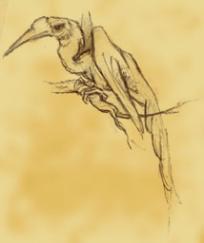
The kongamato is sometimes referred to as “overwhelmer of boats.” It is a giant
bird or bat-like thing that terrorizes the locals of the sub-Saharan continent of
Africa. It is described as a sort of flying lizard, with a wingspan of 3-3 ½ feet. The
kongamato is black or red, with a pointed snout, or beak, filled with sharp teeth. It’
s frequently described as looking like a pterodactyl. This description occurs so
often that some people toy with the idea that it is actually a surviving pterosaur, a
class of prehistoric animals that includes the pterodactyl. Other people say that
perhaps it’s a giant bat. Yet, more people suggest that the kongamato is actually
a stork of some kind. Since many sightings occur at dusk, the light obviously
effects how they perceive the creature. No matter what you say the kongamato is,
it is safe to say “big flying thing.”
Now you may be asking, okay Rebecca, who answered the call of the kongamato?
Not all of these people went out specifically looking for the creature, but once
presented with the kongamato, it became what their trip was about.
The kongamato made its debut in Frank H. Melland’s 1923 book “Witchbound
Africa”. He presented locals with a picture of a pterodactyl, which they
immediately identified as the kongamato. In 1925 British journalist G. Ward Price
and the future Duke of Windsor traveled to Southern Rhodesia. While there, they
heard about local attacks made by the kongamato, stories that they shared upon
their return to Britain. Captain Charles Pitman wrote in his 1942 book “A Game
Warden Takes Stock” about a large pterodactyl-like creature that existed in the
swamps. Dr. J.L.B. Smith investigated the kongamato in the 1950’s to include
them in his book “Old Fourlegs” which was about flying dragons. In 1956 J.P.F.
Brown, an engineer, reported that two prehistoric looking creatures were flying
over head while he was in Northern Rhodesia. This was well publicized in the
papers of the time. Obviously there have been more sightings and stories in and
amongst all these times. That’s all history Rebecca, old news.
Well is 1988 recent enough for you? University of Chicago biologist Roy Mackal
was so intrigued by the history of the kongamato that he packed up and headed
to Nambia in the summer of ’88 to investigate. He collected many stories while he
was there, but unfortunately left without seeing one. One member of his group
stayed behind, and he did report that he saw a giant black glider.
After everything is said and done, there is no proof of the kongamato. No photos
or specimens. Perhaps the kongamato is just a folk tale, something tribesmen tell
each other about to keep them from wandering too close to the water at night.
The African equivalent of the urban legend. It could be that it is, in fact, the lone
surviving pterosaur. Will we ever know? Probably not. Will people keep looking?
Yes, they will, and that, for me is the real story.
The Siren's Song of the Kongamato